

As of April 2026
Summary
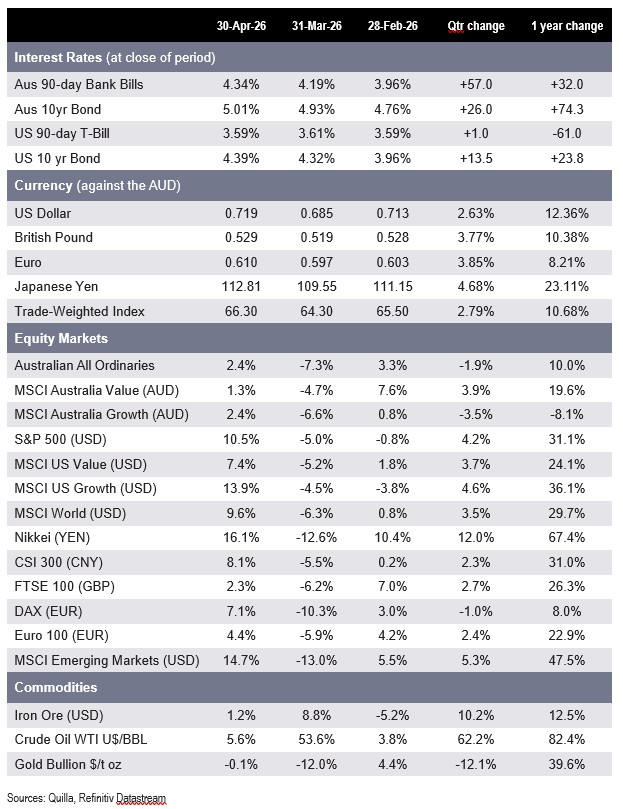
In April, global markets recovered much of the drawdown experienced in March. A fragile ceasefire between the US and Iran took hold, and while the Strait of Hormuz briefly reopened to traffic, restrictions were reimposed later in the month. As a result, crude oil prices were highly volatile—falling from around US$110 per barrel to US$100, before surging to approximately US$126 by month-end amid renewed concerns over escalating tensions.
These developments fed through to economic data and central bank decisions. US CPI rose at its fastest pace since 2022, prompting the Federal Reserve (Fed), Bank of England (BoE), and European Central Bank (ECB) to hold rates steady, citing energy-driven inflation pressures. Despite this, equity markets rallied strongly, with investors looking through short-term inflation noise and focusing on resilient corporate earnings, potential supply-side improvements, and cautious optimism around renewed Middle East peace talks. Gains were more subdued in oil-importing regions.
The Australian equity market underperformed global peers, weighed down by concerns over fuel security as shipping disruptions in the Strait of Hormuz persisted late into the month.
Australian 10-year bond yields traded largely sideways throughout April. Meanwhile, the Australian dollar strengthened materially to just under US$0.72, supported by expectations of relatively more hawkish rate settings and firm commodity prices. Gold prices remained stable, albeit below their January peak.
Selected Market Returns (%)
April 2026
Key market and economic developments in April 2026
Financial markets
April delivered a sharp V-shaped recovery in most major global equity markets after a geopolitically driven selloff in March. The rebound was led by US technology and emerging markets, while the ASX lagged its peers. The recovery was complicated by continued unease in the US-Iran standoff, which pushed oil prices higher, whilst questions over OpenAI’s revenue trajectory drove late-month volatility in the AI complex.
Australian equities
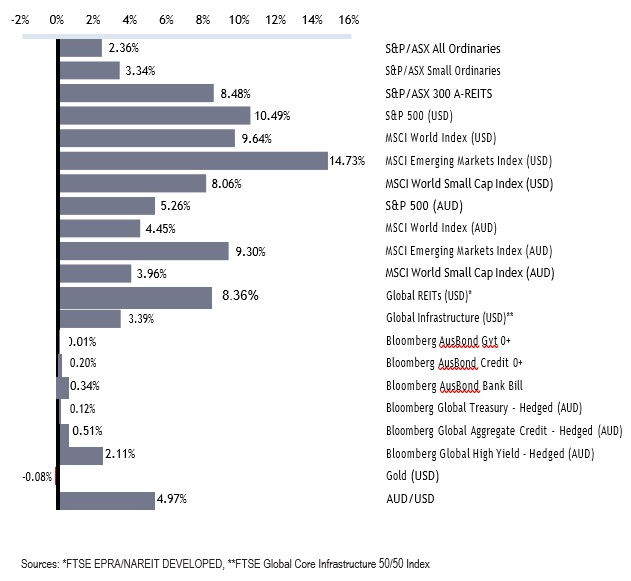
The S&P/ASX All Ordinaries Index rose 2.36% over the month, recovering only part of March’s 7.3% decline. Australian equities were weighed down by the strength of the Australian dollar, elevated oil prices, and increasingly hawkish expectations from the Reserve Bank of Australia (RBA).
The ASX 200 resources sector gained 3.13%, supported by ongoing strength in oil and base metals, with energy producers and iron ore miners leading the advance. In contrast, banks and consumer-facing sectors lagged, as higher interest rate expectations pressured rate-sensitive areas of the market. Small caps outperformed large caps, staging a notable rebound. The S&P/ASX Small Ordinaries Index rose 3.34%, with gains largely driven by defence and technology stocks.
Global equities
Global equity markets staged a strong recovery in April. The MSCI World Index rose 9.6% (USD), more than recouping the negative performance in March. However, the dispersion among regions was significant.
In the US, the S&P 500 rose 10.5% (USD), with the Nasdaq 100 leading the recovery as growth stocks experienced a rebound in valuations that had compressed in March on uncertainty. The recovery was driven primarily by a resilient first-quarter earnings season and a broad-based bounce from late-March lows. AI-related stocks contributed, but with growing dispersion: investors increasingly distinguished between
AI capital expenditure that has been visibly monetised, seen in Alphabet and Amazon Web Services, and capital expenditure without visible monetisation in Meta. The shift was first signalled by reports highlighting OpenAI’s revenue and weekly active user misses.
Japanese equities posted a sharp recovery with the Nikkei 225 up 16.1% (JPY) as the yen weakened modestly and energy-cost concerns abated relative to peak panic.
Emerging markets soared in April. The MSCI Emerging Markets Index rallied 14.7% (USD). Despite continued Middle East disruption, emerging market equities benefited from a softer USD trajectory, a renewed risk appetite and a strong rebound in AI hardware stocks that make up a large portion of emerging market indices.
Commodities
Crude oil remained the key focus. Brent crude continued to grind higher through April, ending the month 12.63% at US$114.15. The United Arab Emirates (UAE) announced on 28 April that it would exit OPEC+ effective 1 May. The decision reflects a long-standing UAE-Saudi disagreement over output policy and has implications beyond the war in the Middle East, with the UAE likely to pump oil unconstrained once shipping through the Strait of Hormuz normalises. Gold consolidated throughout the month following March’s retreat, remaining flat.
Bond markets
Bond markets continued to face a hostile backdrop. After a brief reprieve in early April as risk-off conditions eased and yields retraced, the US 10-year Treasury yield finished at 4.39%, driven by the Fed’s most divided rate decision since 1992: an 8-4 vote to hold. Three regional presidents dissented against the statement language signalling a bias toward cuts, and one governor dissented in favour of a 0.25% cut. Following the decision, money markets abandoned bets on a Fed rate cut through March 2027, with traders increasingly pricing the possibility of a hike in 2027. The Fed’s statement explicitly cited inflation as elevated, partly due to the recent increase in global energy prices.
In Australia, the 10-year government bond yield oscillated around 5% through the month, with markets continuing to price further RBA hikes after the March quarter inflation data release.
Economic developments
The Iran war and the tentative ceasefire
April opened with the US-Iran conflict at peak intensity. President Trump warned Iran of “complete demolition” and deployed further military assets to the region. Oil broke above US$100 per barrel on the back of the supply shock. A tentative de-escalation arrived early in the month. While markets responded with a sharp rally, the truce proved fragile, and shipping through the Strait of Hormuz remained restricted. Knock-on effects continued to build through the supply chain: insurance costs for Gulf shipping rose sharply, and listed corporates, including Worley, Qube, Boral and Transurban, all flagged earnings hits from the disruption. Global defence budgets were also being lifted, with Australia’s own boost of $53 billion over the next decade announced mid-month.
Growing inflation pressures
Preliminary data showed US Q1 2026 GDP grew at a 2.0% annualised rate, rebounding from 0.5% in Q4 2025 but still slightly below expectations. Growth was driven by investment, exports, consumer spending and government outlays amid the backdrop of the Middle East conflict. AI investment was estimated to be around half of all GDP growth. Additionally, jobless claims came in at 189,000, the lowest level since 1969, and Personal Consumption Expenditure (PCE) inflation, the Fed’s preferred measure for assessing price increases, was 3.5% over 12 months, well above its 2% target.
Australian inflation, measured by the Consumer Price Index (CPI), was better than expected but still above the 2-3% target band. Headline CPI measured 4.6% while trimmed mean CPI, which removes the effects of volatile items in the inflation basket, came in at 3.3%. The Fed, ECB and BoE all held rates over April, with the direction of interest rates expected to diverge further between the RBA and global peers. Australia entered April with an environment that is more exposed to the energy shock than other countries without policy flexibility. The data flow and official commentary over the month did very little to soften that view. Westpac’s consumer sentiment index plunged 12.5% on petrol prices and business confidence in the NAB Business Survey recorded its second-largest drop ever.
The unemployment rate, however, remained at 4.3% month-on-month, and the RBA delivered notably hawkish comments in the lead-up to the April CPI release.
Outlook
The global economic outlook became more uncertain in April, with the US-Iran conflict and broader economic conditions adding to inflationary pressures and influencing central bank decisions and bond yields. While these dynamics present near-term challenges, the underlying picture is more nuanced than headline risks suggest.
For risk assets, the near-term trajectory will be heavily influenced by the resolution or escalation of the Iran conflict, particularly for energy-importing markets. A prolonged conflict or escalation would weigh on the global economic growth outlook and corporate earnings growth. Despite the volatile backdrop, the AI investment theme remains a powerful tailwind, with capital expenditure, productivity gains and earnings momentum continuing to support both economic growth and equity markets globally.
We continue to monitor the situation in the Middle East closely, particularly the duration of oil supply disruptions through the Strait of Hormuz and the potential market impacts. Near-term conditions are likely to remain volatile, and portfolio adaptability and diversification remain important.
Major market indicators & portfolio performance