

In summary
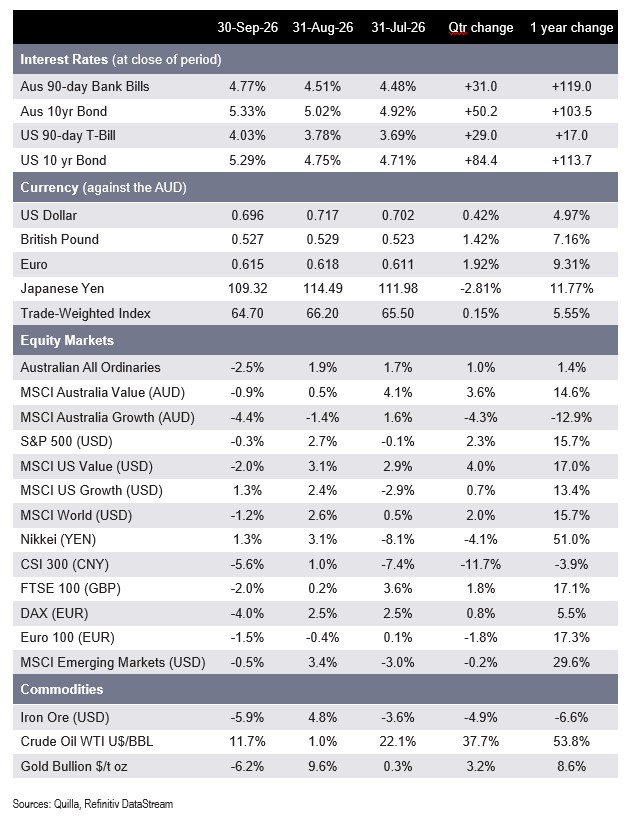
September delivered mixed returns across global markets. Global equities were broadly positive in Australian dollar terms, supported by a rebound in technology stocks that drove gains across US and Asian markets. In contrast, markets with less exposure to the technology theme generally lagged. Australian equities fell 2.5%, as concerns around the domestic economic outlook intensified and weaker commodity prices weighed on the resources sector.
As widely expected, the Reserve Bank of Australia (RBA) raised the cash rate for a fourth time in 2026, adding further pressure to household and corporate finances and weighing on domestic economic sentiment. The US Federal Reserve also raised interest rates for the first time since 2023, reinforcing that persistent inflationary pressures remain a key global challenge for central banks.
Bond yields had one of the largest monthly increases on record during September, as a confluence of fundamental and geopolitical factors pressured fixed income markets.
US economic data remained surprisingly resilient during the month. Non-farm payrolls continued to demonstrate strength, while the ISM Purchasing Managers’ Index (PMI) reached its highest level since 2022. In addition, the real-time economic growth estimate by the Atlanta Fed’s GDPNow showed economic growth at a remarkable 3.7%. Despite the strength in economic activity, bond markets remained under pressure. Ongoing conflict in the Middle East, together with an unsuccessful intervention by the US Treasury to stabilise the Treasury market, added further pressure to bonds globally. The US 10-year Treasury yield reached 5.29% during September, its highest level since 2002.
Key market and economic developments in September 2026
Financial markets
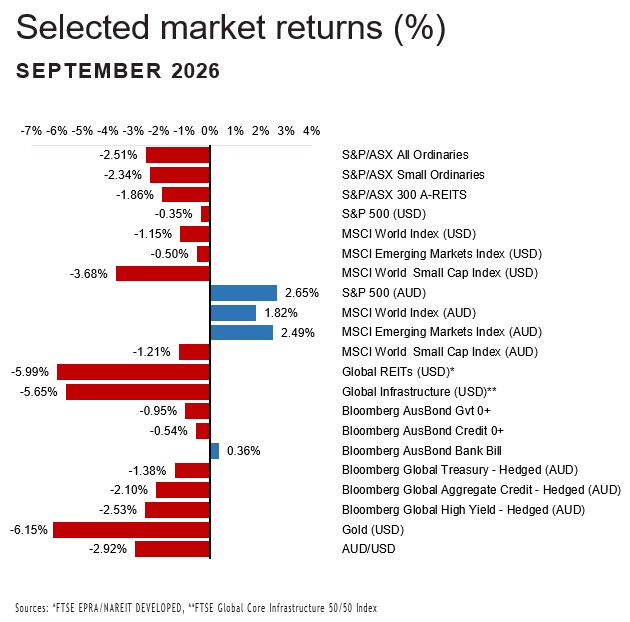
September was a weaker month for markets. Central banks in the US and Australia raised rates as inflation remains above target, pushing bond yields to multi-year highs. Most asset classes fell in local currency terms. A fall in the Australian dollar (AUD) cushioned unhedged investors, turning losses in offshore equities into gains in AUD terms.
Australian Equities
Australian equities fell in September, with the All Ordinaries down 2.5%. Investors priced in further tightening ahead of the RBA’s meeting on 29 September, and growth stocks bore the brunt. The MSCI Australia Growth Index fell 4.4%, compared with a 0.9% fall for the Value Index.
Information technology was the weakest sector, falling 16.3% and reversing August’s 14.7% gain. Materials fell 8.9% as iron ore and gold prices retreated, while consumer discretionary fell 8.3%. Healthcare was the only sector to rise, gaining 0.6% led by an ongoing recovery in key names like CSL and Cochlear, and financials held up well, falling just 0.6%.
Small caps performed in line with the broader market, with the Small Ordinaries falling 2.3%.
Global Equities
Global equities declined, with the MSCI World Index falling 1.2% in USD. The US Federal Reserve’s rate hike on 17 September, and Chair Kevin Warsh’s signal that more tightening may follow, weighed on most sectors.
US equities held up better than most, with the S&P 500 down 0.3% in USD. Information technology rose 6.6% and communication services gained 3.5%. Utilities fell 8.2%, real estate 6.5% and financials 6.2%. Growth outperformed value, with MSCI US Growth up 1.3% and Value down 2.0%.
European equities were weak, with the DAX falling 4.0% and the Euro 100 falling 1.5%. Japanese equities rose 1.3%. Emerging markets fell 0.5% in USD, while Chinese equities (CSI 300) fell 5.6%. The 2.9% fall in the AUD/USD lifted returns for Australian investors. In AUD terms, the MSCI World Index rose by 1.8%.
Rate-sensitive assets struggled. Global REITs fell 6.0%, global infrastructure 5.7% and global small caps 3.7%, all in USD.
Commodities
Oil rose further as conflict in the Middle East escalated, with WTI crude gaining 11.7%. A Houthi strike on Saudi Arabia’s East-West pipeline added to supply concerns via the alternate Red Sea route; however, these concerns dissipated later in the month.
Gold fell 6.2% as a sharp rise in real yields and a stronger US dollar led to weakness. Iron ore fell 5.9% as did most other industrial metals, with copper the outlier which traded up to a record high.
Bond Markets
Bond markets sold off as central banks turned more hawkish. The Fed raised rates by 0.25% to a target range of 3.75% to 4.00%, its first hike since 2023. The US 10-year yield jumped from 4.75% to 5.29%.
In Australia, the RBA lifted the cash rate by 0.25% to 4.60%, its fourth hike of 2026. The 10-year yield rose to 5.33% from 5.02%. Fixed income benchmarks such as the Bloomberg AusBond Govt 0+ fell 1.0% and the AusBond Credit 0+ fell 0.5%. Cash was the only domestic asset class to post a gain, with the AusBond Bank Bill Index returning 0.4%. Hedged global bonds also lost ground. Global treasuries fell 1.4%, global aggregate credit 2.1% and global high yield 2.5%, as weaker risk appetite weighed on lower-quality credit.
Economic Developments
New AI Agent from Meta sparks tech rally
The US technology giant released its newest AI application in September, which is an AI app they called Muse. Muse is a consumer-focused AI agent that seeks to help users manage their calendar, subscriptions, online shopping and reservations, as well as various other lifestyle chores. Muse quickly became the most downloaded free App in the US, breathing new life into Meta’s stalled AI ambitions.
It also led investors to become more bullish on the AI space more broadly, as it represented a potentially exciting AI product channel. The consumer segment hasn’t yet been as successfully monetised as enterprise AI tools such as Claude Cowork or Microsoft Copilot. Companies in the AI supply chain, such as semiconductor manufacturers, rallied on expectations for even greater AI demand.
On the opposite side, some consumer companies perceived as being at risk from AI fell, including subscription businesses like the New York Times (-6.5%) or internet travel company Booking Holdings (-20.5%).
Oil flows continue to normalise from the Middle East
Despite ongoing tension between Iran and the United States, including limited military strikes in September and heated rhetoric from the presidents of both countries at the September UN meeting, oil flows have continued to recover from the critical Persian Gulf region.
Key exporter Saudi Arabia has been stepping up exports through the Strait of Hormuz, despite no final settlement having taken place and the ongoing threat to shipping in the region. Iran’s oil exports remain largely blocked by the US blockade; however, regional crude exports have recovered to 98% of pre-war levels at month-end, according to energy tracking firm Kpler. This has been made possible by the presence of the US Navy operating in the region and new tactics by ship owners to manage the risk of the crossing. Refined products like diesel are still running well below previous levels, which contributes to prices holding at an elevated level for consumers and causing ongoing inflationary pressure.
Outlook
We remain cautiously positive on the outlook for investment markets.
Global share markets continue to be supported by solid company earnings, particularly in the US, where profit growth is being seen across a broad range of sectors. Significant investment in artificial intelligence and related infrastructure is also supporting economic growth and corporate activity. For now, we expect these trends to remain supportive of markets.
However, there are still risks to the outlook. Inflation remains higher than central banks would like, energy prices are elevated, and geopolitical tensions continue in several regions. The risk of further energy price increases is also worth watching, particularly as the northern hemisphere heads into winter with lower energy stockpiles.
Closer to home, the Australian economy remains relatively weak. Higher interest rates, subdued productivity growth and policy uncertainty are weighing on households, businesses and economic confidence. Against this backdrop, we continue to favour Australian companies with greater exposure to overseas markets over those more dependent on the domestic economy.
Overall, we remain modestly positive on shares, with a preference for global markets where strong company earnings and investment in AI are providing greater support. We also continue to see value in holding government bonds as a source of portfolio diversification and income, although we remain somewhat cautious given the risk that persistent inflation could keep interest rates higher for longer.
Major market indicators & portfolio performance