

In Summary
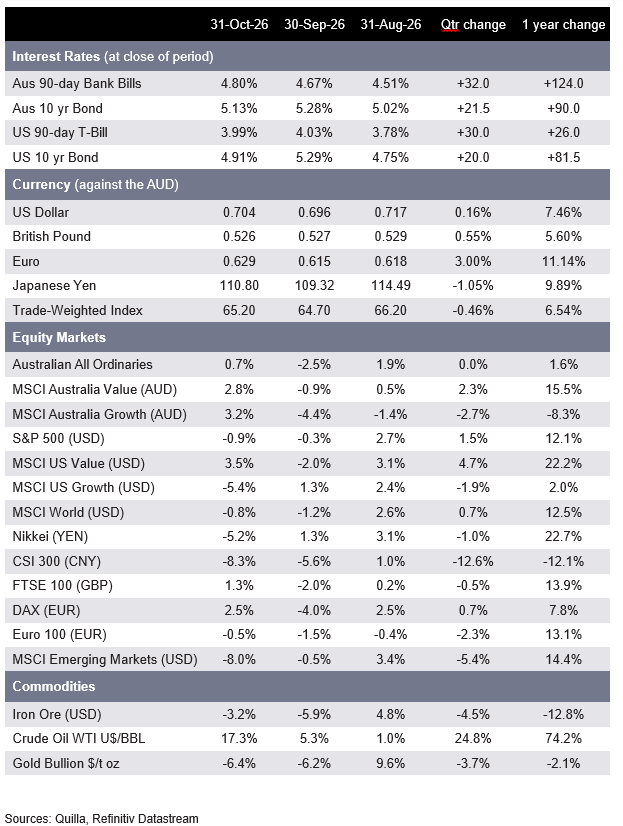
October delivered shifting dynamics across global financial markets. Global equities experienced divergent performance when measured in Australian dollar (AUD) terms, influenced by stabilising international trends, localised earnings revisions, and a highly volatile currency environment. While several international indices paused to digest recent macroeconomic data, market volatility shifted from headline indices down into specific sectors and factor exposures. Domestically, Australian equities remained under pressure as structural economic outlook concerns intensified and central bank tightening expectations heavily weighed on domestic consumer sentiment and corporate credit conditions.
A primary driver of this cautious global sentiment was the evolving stance of major central banks. The Reserve Bank of Australia (RBA) did not hold a formal monetary policy meeting in October; however, market expectations rapidly solidified around an imminent rate increase at the upcoming November board meeting, spurred on by hotter-than-anticipated underlying inflation data and resilient services sector metrics.
Conversely, the US Federal Reserve opted to hold its benchmark rate steady as anticipated, however, the decision was marked by a split vote among board members, highlighting deep internal anxieties regarding sticky core inflation and a surprisingly tight labour market. Fixed income markets bore the brunt of this policy uncertainty, with sovereign yields fluctuating sharply as investors actively recalibrated their long-term terminal rate assumptions amid persistent geopolitical risks in the Middle East.
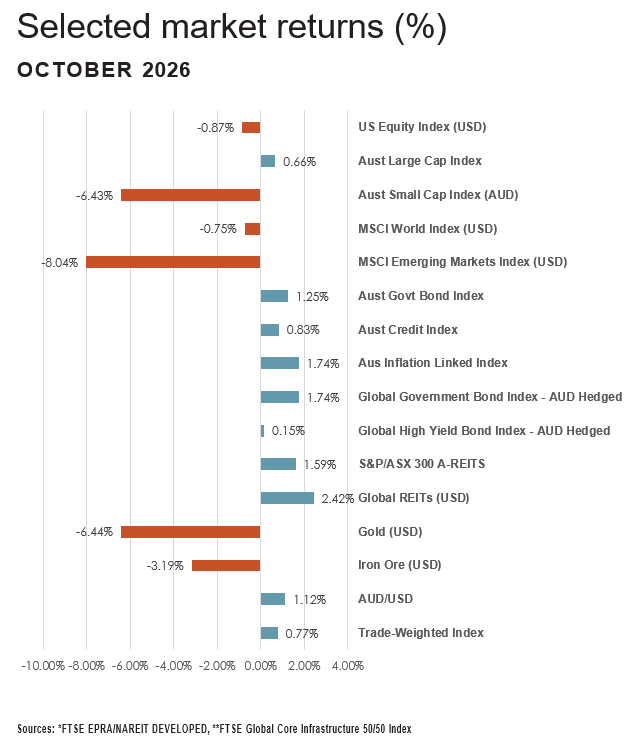
Selected market returns (%), October 2026
Key market and economic developments in October 2026
Financial Markets
October saw a consolidation period for global financial markets, with the MSCI World Index (USD) falling by 0.75%. Most major large-cap equity indexes traded within narrow, highly sensitive ranges in local currency terms.
The Australian share market traded defensively as investors repositioned portfolios ahead of the November RBA meeting. Local economic headwinds, including a sharp correction across capital city housing markets and stagnant real wage growth, suppressed domestic consumer discretionary spending and corporate forward guidance.
The domestic market favoured large-cap defensive positions, with the ASX All Ordinaries closing by 0.66%. Conversely, small caps faced pressure as smaller, growth-oriented companies grappled with high borrowing costs, floating-rate corporate debt facilities, and deteriorating domestic demand.
Global Equities
International equity markets delivered highly fragmented returns as the third-quarter corporate earnings season commenced. While US large-cap benchmarks remained relatively resilient following the Fed’s rate pause, market breadth remained narrow. European indices were dragged down by manufacturing contractions, while Japanese equities fluctuated on Yen valuation shifts.
The artificial intelligence theme underwent a crucial shift from conceptual excitement to hard monetisation metrics. However, rather than attracting capital inflows, hyperscale cloud infrastructure providers and premium semiconductor manufacturers bore the brunt of intense market scepticism. Concurrently, consumer-facing and subscription businesses that failed to demonstrate immediate, tangible AI-driven efficiency gains or cost improvements faced valuation downgrades, with Alphabet and Amazon among these.
Outside of mega-cap technology clusters, global large caps with low leverage outperformed. Global small caps faced headwinds, underperforming large caps as tighter credit lines and elevated debt-servicing costs pressured smaller corporate balance sheets.
Emerging Market equities saw a decline in excess of 9% in AUD terms over the month of October. Chinese equities fell further as early regulatory tweaks failed to revive weak consumer demand. Latin American regions faced capital flight risks driven by local fiscal structural challenges, a surprise result in Brazilian elections, and a strong US dollar.
Commodities
Global energy markets continued to focus on supply security and logistics. While the crude oil spot price spiked by 17.3% to remain structurally elevated, trade channels showed signs of stabilising. Industrial metals traded in specific ranges, with copper continuing to benefit from structural demand. Gold and precious metals reacted dynamically to shifts in real yields and the relative strength of the US dollar.
Bond Markets
Sovereign bond markets experienced heightened volatility as fixed-income participants unpicked aggressive global rate cut assumptions. While corporate credit spreads remained tight, lower-quality high-yield issuance showed clear vulnerability to restrictive liquidity.
Domestically, yields on short-term maturities rose as market participants priced in a prolonged hawkish stance from the RBA extending into 2027. In the US, the 10-year Treasury yield fluctuated near multi-year highs in the 5.20%–5.30% range as resilient macroeconomic indicators forced bond traders to price out near-term rate cuts and subsequently price in the possibility of future rate hikes.
Economic Developments
US growth acceleration and resilient domestic momentum
The United States economy demonstrated structural resilience, firmly outperforming major developed peers. US real GDP grew at an annualised rate of 3.4% in Q3 2026, a substantial acceleration from the 2.2% pace recorded in Q2. This economic momentum was heavily underpinned by a robust 3.8% expansion in private consumption alongside a 19.4% surge in private domestic investment, driven aggressively by artificial intelligence infrastructure and IT equipment spending which soared 20.9%. This domestic strength successfully offset declining export volumes and insulated large-cap corporate margins from higher-for-longer borrowing costs.
US growth acceleration and resilient domestic momentum
In stark contrast to the US, the Eurozone and Australia faced structural headwinds and clear signs of economic fatigue. Preliminary flash estimates showed Eurozone GDP growth slowing to 0.4% quarter-on-quarter in Q3 2026, dragged down by a 0.1% contraction in France and flat growth in Italy. Concurrently, Australia is experiencing acute domestic pressure. Hotter-than-expected consumer price data showed monthly Consumer Price Index (CPI) growing by 0.8% in September, keeping quarterly inflation pressures elevated. Domestic GDP projections were subsequently revised down to just 1.0% by mid-2027, while anticipating unemployment to continue to trend up as restrictive central bank policies further compress household budgets.
Outlook
We maintain a moderately positive outlook for investment markets, though near-term asset allocation requires strict selectivity.
Global equities continue to find structural support in solid corporate earnings, particularly in the US, where capital expenditure on artificial intelligence and digital infrastructure remains a powerful economic driver. Nonetheless, acute macro risks persist. Inflation remains structurally above the long-term targets of major central banks, and tight labour markets alongside elevated refined energy prices mean interest rates are likely to stay higher for longer.
Domestically, the Australian economy faces distinct headwinds. Subdued productivity, falling home prices, and the cumulative impact of aggressive rate hikes are dampening household consumption and corporate pricing power, which will continue to weigh on domestic assets.
Overall, markets are facing a balance of positive structural growth drivers with intermediate-term challenges, requiring investors to remain adaptable.
Major market Indicators